

Tidal Fence Generation
Tidal Fences Harness the Power of Moving Water
 A Tidal Fence is another form of tidal stream technology, which directly exploits fast flowing underwater ocean currents for energy generation using the natural flow of tidal currents without the use of a dam. In many ways, a tidal fence installation is a hybrid between a tidal barrage and a tidal turbine stream system.
Unlike submerged hydro turbines which are individually positioned around the oceans floor, tidal fences are composed of a series of individual vertical-axis turbines that are mounted together horizontally beneath the surface of the sea within a single fence like structure, (hence its name) across a channel or estuary.
Then the purpose of the fence, also known as a “caisson”, is to harness the kinetic energy of the slow moving underwater tides. This arrangement forces the seawater through the caisson gaps, which spin the underwater turbine blades, capturing its energy and generating power.
Then tidal fence generation represents an innovative approach to harnessing the immense power of oceanic tides. They can offer a less environmentally invasive alternative to the larger tidal barrages or dams since they are designed to allow water to flow freely through them.
Also, the energy output from tidal fences is predictable and consistent, as the oceans tides follow a regular lunar cycle. This makes it a reliable source of renewable energy and so are generally installed in channels between landmasses, such as straits or estuaries, to capitalise on strong tidal currents.
How Can Tidal Energy be Harnessed?
Tidal fences and lagoons are another great way in which we can harness the free energy created by tidal energy. These fences or caissons act like a submerged barrier across an inlet or estuary, while lagoons act as energy storage systems by creating enclosed areas to capture the water at high tide and release it back through the turbines at low tide.
Both systems are used to generate electricity from the natural ebb and flow of the tidal currents. Unlike a tidal barrage, tidal fences do not block the flow of the moving water and because the turbines sit horizontally beneath the surface of the sea, they can be sited in shallower water making them cheaper to install than a solid concrete tidal barrage.
As its name suggests, a “tidal fence” is just that, resembling a long open steel or concrete structure. Tidal fences are used in fast flowing areas such as the channels between two land masses where it directs the sea water to the turbines when it passes through the fence.
Since their structure is open, tidal fences have less impact on the environment than a solid tidal barrage type wall or dam, but they can still disrupt the movement and migration of fish or large marine animals.
To overcome this problem, wide openings between the caisson wall and the rotating turbines allow fish to swim past it, unlike a tidal barrage which often prevents fish from swimming in and out of a basin when the sluice gates are closed.
Also being a fully open design, a tidal fence has no effect on the movement of the waves above it on the surface, or on the corresponding tidal sea levels either side of the tidal fence. Thus extracting the tidal energy from the sea using fences is a more environmental way of electrical power generation.
A Tidal Fence Structure For Energy Capture
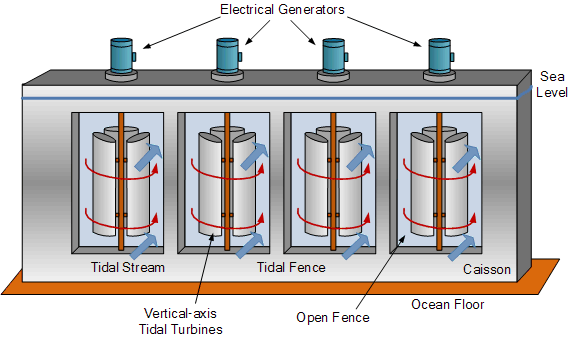
Generally, a tidal fence uses individual vertical axis cross flow turbines, similar to Savonius Rotor or Darrieus Helicoil wind turbines, lined up below the surface of the water in a single row. As the fence is fully open, there are only slight differences in water pressure between the incoming and outgoing sides of the fence which results in a relatively slow water current speed flowing through the fence, but this is offset by a large volume of water.
One way to overcome this problem is to decrease the cross-section of the opening, forcing the water to flow through a smaller opening which significantly increases the tidal current velocity through the turbines.
Advantages Of Tidal Fence Generation

One of the main advantages of tidal fence generation is its reduced environmental impact. Since it is less disruptive to fish migration and shipping than large tidal barrages (dams). Also it can be more cost effective to build and operational compared to other ocean based energy systems, especially in lower flow areas.
Another clear advantage of a tidal fence is that all the electrical generators, machinery and cabling can be kept high and dry above the water line where they can be easily accessed for maintenance and repair.
Also, unlike a tidal barrage scheme that fully span an estuary requiring a closed estuary or basin, a tidal fence can be used in open tidal channels between the mainland and a nearby island, or between two islands with sufficient tidal stream.
They are also able to generate electricity as individual modules connected together, rather than just one complete installation as in the case of tidal barrage schemes. This design reduces the significant ecological impact associated with barrages, which can alter sediment flow and obstruct fish migration.
A Tidal Fence has much less impact on the environment than other forms of oceanic tidal generation, as they do not require flooding of a basin and are significantly cheaper to install using less concrete and steel. But tidal fences are not free from all environmental or social concerns, as a caisson structure is still required.
This fence like structure can disrupt fish migration and block both local navigation and shipping. In order to reduce the dangers to fish, the tidal fence could be engineered so that the spaces between the caisson wall and the rotor foil are large enough to allow fish to pass unaffected.
Tutorial Summary
We have seen here that tidal fences can be used to generate electricity using the natural flow of tidal currents without the use of dam like structures. It works by utilising the bi-directional ebb and flow of the worlds tides and oceans, passing through vertical axis turbines mounted in a fence producing clean energy from both the incoming and outgoing tides.
There are many advantages in using tidal energy due to their modular nature allowing for scalable deployment, while adapting to various channel widths and tidal currents between two landmasses.
The first advantage is that the ocean is a reliable energy source to replace the burning of fossil fuels. In addition, it is a renewable source of energy that provides no waste product such as greenhouse gases. It needs no fossil fuel to power it and it generates electricity more efficient than wind and solar power using the predictable power of the tides. This makes tidal fences a promising technology for sustainable tidal energy extraction, balancing power generation with environmental preservation.
Tidal stream generation whether by using tidal turbines on the ocean floor or a tidal fence across an open channel has little environmental impact generating electrical energy without producing pollution. They can be built in many different places around the world as there is a lot of renewable tidal energy around our coastlines which could be harvested to provide a source of free alternative energy.
Learn More About Tidal Fence Generation
To understand more about “Tidal Fences” and how they generate electricity using just the movement of sea water, or obtain more tidal energy information about the various tidal energy systems available.
Then order your copy from Amazon today of: Harnessing Wave and Tidal Energy and see how the future of power generation can come from the sea.


Tidal Fences and Underwater Tidal Fence Turbines can harness the power of tides for sustainable energy
Can a fence be attached to a boats hull ? Thanx
No, As explained in the tutorial, tidal fences are a line of individual vertical-axis turbines mounted within a fence like caisson structure. They are stationary structures usually located between land masses, to capitalise on the tidal currents flowing around coastal waters.
A tidal turbine could be positioned beneath a boat to generated power from the fast-flowing volumes of water caused by the motion of the tide beneath the boats hull when stationary. But the drag force on a moving (sailing) boat, no matter how good the hydrodynamics, would off-set and power generated. For sailing boats, wind turbine generators and/or photovoltaic panels on deck are still a better option to charge marine batteries.
How long do tidal fences last on average?
That would depend on the expected, or required life-cycle, and therefore the design specifications of the tidal fence, the same as for any product.
For a project, are there any of these in operation around the world
Who is the author of this? Need it for a research report
Alternative Energy Tutorials
Thank you
who is the author? i need this for a project so i can cite from here. Please email me at cody16.raven@gmail.com as i wont be always checking this website.
How did the project go btw?